You might not realise it, but the UK has a wide and variable geology under our feet.
This includes large areas underlain by rocks like salt, chalk, gypsum and limestone that are susceptible to dissolution – a significant risk to housing developments.
But what actually is dissolution and what should you do about it?
The science in a nutshell
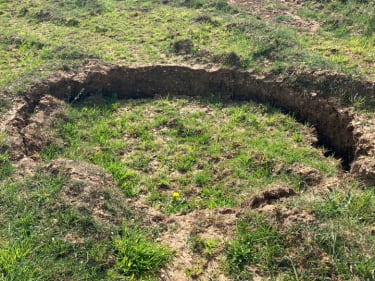
In its most basic form, dissolution is where bedrock is dissolved by groundwater, leaving behind a void.
Depending on the type and depth of the rock, as well as the geology above, this can result in variable ground conditions, excessive settlement or, more concerning, the development of sinkholes at the surface of a site.
Dissolution can occur anywhere where groundwater can infiltrate dissolvable rocks, meaning the risks resulting from dissolution vary from site to site and rock to rock.
For example and as explored in the NHBC Foundation’s Building Foundation Solutions – Future Proofing Against Climate Change report, naturally occurring sinkholes can develop within decades in gypsum surrounding the North Yorkshire cathedral city of Ripon, seriously affecting hard-to-predict and discreet areas.
In Worcestershire, meanwhile, the brine extraction of salt underlying Droitwich Spa has been exploited by humans since Roman times and affects a wide area slowly, with the resulting settlement being well understood and manageable.
That’s why when considering a development in an area susceptible to dissolution, it’s important that the risks are appropriately investigated, assessed and managed to protect future homeowners.
The right assessment approach
Dissolution features can risk both houses and external areas, so ground models must be sufficiently developed and robust to allow mitigation to be designed.
Where soluble rocks have been identified in the desk study, traditional intrusive investigation is almost always the first option considered for determining ground risks.
But unless sinkholes or surface depressions are visible, boreholes and trial pits alone are unlikely to identify all features on a site because of their limited coverage and small sample size.
And in areas containing gypsum, which is extremely sensitive to water ingress, you must be incredibly careful when decommissioning investigation points to ensure they do not become a preferential pathway for groundwater in the future.
NHBC is increasingly seeing geophysical investigations used to provide evidence for risk assessments.
There’s no denying the wealth of information that can be quickly obtained from geophysics and we welcome its use.
But as with all investigations, it’s important to match the technique to the site, the prevailing ground conditions and the subject of interest.
We have seen instances where an inappropriate technique has been used, leading to results of little relevance or no use to the dissolution assessment.
In other cases, geophysics has been used in isolation, with no calibration from physical investigations, leaving uncertainty about the veracity of the results.
This is why we always recommend pursuing multiple lines of evidence when gathering information; combining a review of desk information, an appropriate geophysical investigation and then a targeted physical investigation.
Case-by-case solutions
Once the risk from dissolution has been established, a range of engineering options is available, including enhanced foundations, engineered earthworks, geotextiles or ground improvement.
If sinkholes have already developed at the surface of a site, it may sometimes be too risky for residential properties, meaning an exclusion zone is more appropriate.
Given the variability of the risk, the project team must remain agile and react to the results of the investigation instead of assuming everything will be alright.
We often see a range of technical solutions on the same site and sometimes proposals sit outside of NHBC's Technical Risk appetite or Standard Guidance, requiring careful consideration before we can accept them for our warranty.
Any mitigation must always be well considered to protect homeowners for the lifetime of their property.
NHBC has insured thousands of homes in dissolution areas and has the history and knowledge to know what works and what does not.
Our Land Quality Service provides early engagement to assist at any stage of a dissolution assessment, with a team of Specialist Geotechnical Engineers who can provide advice about your investigation and remediation plans.
Our advice can help de-risk your land and provide a smoother pathway to warranty – while giving you confidence and reassurance around such a variable and complex issue.
Talk to us
Speak to our specialists early to reduce risk, avoid delays and unlock the full potential of your land.


