With the busy late spring/early summer conference season drawing to a close, it’s a good chance to reflect on some of its most interesting trends and discussions.
This year’s UK’s Real Estate Investment and Infrastructure Forum, or UKREiiF, welcomed key players from right across the housing market.
And thanks to a partnership between NHBC, the Future Homes Hub, Homes England and Barclays, the event also hosted the Future Homes Pavilion – where some of the biggest names from both the private and public sectors gathered to share unique insights to a select audience.
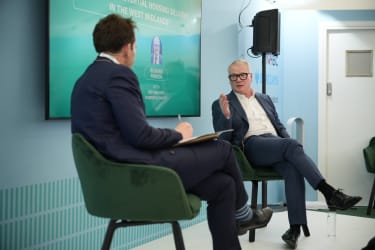
One such session saw Mayor of the West Midlands, Richard Parker, in conversation with NHBC’s Tim Reid about how his region is overcoming the many challenges holding back housing delivery across the country.
So what can other regional authorities learn from the West Midlands, and how is a new approach to collaboration unlocking much-needed investment?
Vital issue. Complex work.
It’s fair to say that boosting new home construction is a central focus for Parker and his team.
His successful election to the mayoralty in 2024 followed a manifesto pledge to “fix the housing crisis and crack down on rogue landlords”, with plans to “build 20,000 extra homes in the region by 2031”.
Those big ambitions are matched by big opportunities.
The size, geography and economic history of the West Midlands mean it contains a preponderance of brownfield land with regeneration potential.
The tight proximity of multiple cities and towns also makes transit-oriented development more of a prospect than it might be in more rural, less-connected areas.
Yet for all the reasons for optimism, there’s no denying the wide-ranging stumbling blocks that the West Midlands Combined Authority – like all its counterparts across the UK – must overcome to turn proposals into properties.
In his conversation at the Future Homes Pavilion, Parker explained how under-resourced planning departments is chief among them, often delaying and frustrating projects.
So too is addressing the unique housing needs of a particularly young and diverse population; one-third of people living under the WMCA’s jurisdiction are under the age of 25, making it one of the youngest regions in Europe.
That means not only attracting the required investment to deliver new builds, but ensuring it leads to the right kinds of housing most needed by those who call the West Midlands home.
Taking control
Nevertheless, several flagship housing projects have recently been delivered by the WMCA.
And, as Parker told the audience at the Future Homes Pavilion, some of the strategies used in that time could help other regional authorities navigate their own circumstances, too.
Perhaps the most significant among them is the use of Mayoral Development Corporations, or MDCs, which Parker is a strong advocate for.
Essentially, MDCs are regeneration bodies that can be set up to drive forward the development of specified sites and empower metro mayors like Parker with extensive powers to recruit project experts, install infrastructure, construct buildings and – crucially – act as the planning authority.
WMCA recently approved the biggest MDC in the country, with the Birmingham Mayoral Development Corporation aiming to transform city-centre locations, improve public spaces and unlock thousands of new homes.
Expanding the workforce
As well as efficient planning processes and decision making, delivering housing at scale and speed relies on access to skills.
It’s no secret that the construction industry needs to attract more young people, with around a quarter of workers aged over 55 in 2023.
Parker highlighted this skills crisis in his chat at the Future Homes Pavilion, detailing how regional authorities can play a crucial role in helping to address it.
In the West Midlands, this is being done through the Building Growth Action Plan, a wide-ranging set of initiatives delivered through collaborations with further education providers, employers and sector bodies that aim to deliver 12,000 additional skilled workers.
Right place and time
Of course, public-private partnerships also play a role in providing the funding required to get developments off the ground.
Money available to Metro Mayors thanks to devolution can be targeted towards projects that combine the right kind of housing with the ideal site for regeneration, such as the construction of 108 affordable homes – including 72 social rent properties – on a former electric power site in Warwickshire.
But cash may also be diverted to resurrect projects like a 71-social-rent-home scheme in Walsall that have stalled due to the financial difficulties of developers or other issues delaying work on site.
A nationwide mission
The picture in the West Midlands is bright.
In 2025, NHBC registration figures showed a 29% year-on-year rise in new home construction – making it the highest-growing region in the country.
But with strong collaboration and a similarly consistent approach, other areas of the UK can follow this lead and achieve impressive results for their residents.